Monday, November 7, 2016

The Importance and Struggles of Voting

An Opinion Piece from Hub SPEA Service Corps Fellow, Kirby Jewell
For the last couple of weeks, our team at the Hub has been advocating for our patrons and community members to register to vote, request an absentee ballot, get informed on the candidates and issues, and ultimately vote in the upcoming General Election. We believe voting is essential to creating the systemic change that eliminates food insecurity and poverty. While raising awareness is a great way to begin, we cannot make lasting and meaningful changes to break the cycle of poverty without legislative action. Our voter registration push was the first step, and we are inspired that so many people have shown an interest in these efforts so far.
While at the Hub many preach the importance of voting, we also acknowledge that there are many barriers to voting, and that many feel disempowered by the current political system.  From finding information on candidates, understanding what the different positions are, figuring out where you vote, or just getting an idea of what you have to physically bring with you to the polls in order to prove your identity, the entire process can be overwhelming. These problems inevitably dissuade many people from going through the process in the first place. But these issues exist for a reason and that reason is to keep folks experiencing poverty from showing up and voting their interests. By suppressing the vote of those who are often voiceless, officials are able to maintain the status quo. Justifiably, this reality makes many feel powerless, and thus less likely to make the effort to vote.
I was faced with a situation recently that tested how much I was willing to push to have my voice heard in the General Election. I experienced firsthand the attempts that government officials make to deter people from voting - the same attempts that subconsciously urge voters to not put in the effort and forgo voting. I have no doubt that officials at my local Board of Elections were trying to suppress my vote, first by “misplacing” my absentee ballot, and then by reissuing my ballot to the wrong address 5 hours in Ohio away from my home in Bloomington. My faith in the system was shaken as a result of this ordeal, and I made sure to write to my Secretary of State twice to ensure that he was going to act on the matter.
But on my drive back to Bloomington after I had finally cast my ballot, I was left wondering how many people out there, faced with the same dilemma as me, simply gave up. I will readily admit that I am not the typical voter, and that I may be one of the few people left who gets genuinely excited when election season rolls around. I am a rare case, which means that if people were facing the same problem as me, maybe they would just “hope for the best” and see if their ballot shows up before the 8th, which was the advice given to me when I called the Board of Elections. Even though I was not going to let anything stop me from voting, there were times when I really wanted to give up, and I questioned whether or not all of this effort was worth it. But I always came to the same conclusion: it absolutely was.
The election system is difficult enough to navigate, and there are barriers at every step to deter people from voting. These barriers are amplified for those who are faced with issues like food insecurity and poverty, because those are the people who, if empowered, can force the systemic change our system so desperately needs. My hope is that your takeaway from this is that you must keep pushing to have your voice heard, and voting is an important step in accomplishing that goal. Maintaining the status quo is what many elected officials strive for, and they do this through making the process burdensome and complex, and sometimes through outright voter suppression. While this realization may cause people to lose all faith in the system, it only reaffirmed my belief that this fight to have our voices heard is worth it. Once I recognized that resigning to my fate of not being able to vote is exactly what was expected of me, I knew what I had to do. If you are registered to vote but have not decided whether you will head out on Election Day, just remember that our fight to change this broken system can only begin with your defying act - so vote!

Friday, November 4, 2016

The Hub Food Cycle Shake Down

Hey Hub folks, Kristen here.  As many of you know I field dozens of questions a week, if not daily about where our food comes from, and generally why we have so little control over our stock. You have likely noticed that lack of control results in periods of low food supply.  In the name of efficiency and transparency, I would like to explain to you the ins and outs of how the Hub food pantry's food distribution works from day to day.  To paint you a broad picture, the history of food assistance is embedded in rerouting “waste” and “excess” food from the market and into charities that serve those experiencing hunger.  As much as we rely on this system, we are critical of it.  We believe that everyone, regardless of income, deserves access to the food they need, and that there are problematic assumptions in the belief that one’s waste is another’s sustenance.

Photo above is a box of food donated by a local grocery store.


We receive approximately 97% of our food from the Hoosier Hills Food Bank, 2% from direct donations throughout the community and 1% from our organic Hub gardens.  MHC pays a small shared maintenance fee per pound of food to the Hoosier Hills Food Bank to access this product.  Each year, MHC budgets upward of $30,000, to pay for food product that has a retail value of nearly 1 million dollars.  There are a handful of items that we do not have to pay a shared maintenance fee for, like bread and produce.  This is why we can easily say that for every dollar donated, we can obtain 10lbs of food.

Pictured above is commodity food from TEFAP


You have likely heard us talk about TEFAP food.  TEFAP is The Emergency Food Assistance Program, which is commodity food that comes down from the government through food banks to organizations like ours.  We are very reliant on this ongoing input of commodity food, and the administration and quantity of this food is controlled by government policies.

The selection of food in our pantry that we are the most proud of is the local produce.  A small amount comes from our onsite food pantry garden and our off site Butler Park garden.  But the majority is funneled through programs of the Hoosier Hills Food Bank: the Garden and Gleaning Program and the Plant a Row for the Hungry Program. There is no shared maintenance fee for any of this produce.

Photo above is a particularly glorious day of local produce in the food pantry.


MHC receives a truck from Hoosier Hills nearly every day of the week, delivering donations from the food bank and from local groceries stores.  What these trucks have on them is entirely dependent on what the grocery stores have marked as “waste” for that day.  We could receive anywhere from 2-8 pallets of food on any given day.  There is no guarantee that there will be any certain item on the truck, i.e. bread, produce, meat, dairy, etc.  
We also do two shopping trips a week at Hoosier Hills Food Bank.  During those trips we try to fill our truck with as much nutritious food as possible.  This is a challenge many times, as there is no way of knowing what will be on the shopping floor of the food bank.  Some days the floor is filled with food, other days there are few items.  Hoosier Hills Food Bank is reliant on donations and the Feeding America network, and cannot control the consistency of their stock.

About 1100-1200 people come through the food pantry each week, and considering those in their household who may or may not be present, almost 4,000 total individuals receive food from the Hub each week.  We have looked into bulk wholesale purchasing multiple times and each quest has come up with the same result.  It is too expensive to make a noticeable difference in the pantry.  For example, we could purchase a pallet of food and it might last 2-3 days in the pantry but use an entire month’s worth budgeted food expenses.  

It would be ideal if our pantry always had a reliable amount of healthy food to supplement a household’s needs.  Unfortunately, that is not the reality of our national emergency food system’s distribution model.

Relying on waste as a method of providing food will always mean uncertainty for food banks, food pantries, and the individuals and families we serve. To add to these frustrations, keep in mind that the disfunction of distribution is just one part of the issue of national and local food security - it doesn’t account for the root causes of food insecurity that we know need to be addressed, like poverty, oppression, stigmatization and isolation. There are no quick fix solutions to the broken system dealing with food insecurity, but being transparent about the issues is a starting point. As a community, let’s keep talking about it.

If you have any follow-up questions, please feel free to talk to me at the pantry, or to email at operations@mhcfoodpantry.org.


Thursday, October 6, 2016

The 6th Annual Garden Gala

On September 24, Mother Hubbard's Cupboard hosted their 6th annual Garden Gala. 
The Gala is an event designed to promote and celebrate the beautiful gardens at Mother Hubbard's Cupboard and the community it has created. Many guests attended the event dressed in their best formal attire. 

Drinks and food were donated by many local businesses, which helped to get the party started. Some of these businesses included Cardinal Spirits, Kroger, Rainbow Bakery, Malibu Grill, King Dough, and many delicious others.


Garden tours were given out to guests who wanted to further explore the abundance of food, that the hub has growing for their community. Some of the food found in the gardens during these tours included beans, peppers, peas, lettuce, kale, and many more goodies.


Music was played throughout the night, which included an appearance from the local band The Vallures and a live DJ, as people danced the night away.


Guests took the time to purchase raffle tickets throughout the night to try their luck on different prize packages. Some of these prize packages included local date night options, pampering opportunities, a chance to hold the local famous cat Lil bub, a trip for 4 to Disney, and many more. The night was clearly a success.


The Hub wants to thank everyone who put in the time and work to pull off this spectacular night and the generosity of every business that donated many items. We hope to see everyone again next year!


Thursday, September 15, 2016

Exercising Your Right

Many passionate volunteers have gathered in the food pantry over the past couple weeks eager to help the Hub community exercise our right to vote. Stamps and envelopes have been bought, education boards have been made, and signs have been drawn up.

                
This year the Hub wants to offer an opportunity to vote. In order to do this we are providing voter registration and education. There are two different ways you can register this year. Paper forms are available to be filled out along with envelopes and stamps, in order to mail out completed forms. If you are in a hurry, forms are available to take home.

Not sure who to vote for? Some of the Hub's interns have made a balanced, nonpartisan  informational board regarding the different candidates running in the 2016 election and their platforms. A packet is also available to take home which offers the same information.

Not sure if you are already registered? There is an online website where you can check whether you are already register. This website also provides a lot more information regarding the election. Name and addresses changes may also be made online or through the form.

Not sure if you want to vote? Even if you are not interested in voting in the Presidential election, it is possible to choose to focus your ballot on local candidates.

Not sure if you will be available the day of the election? Absentee ballots are available at the Hub along with registration forms. These can be filled out by anyone who is not able to be present to vote on the day of the election. Information will be provided on where and when you can vote early.

Stop by the Hub and register today!

Wednesday, August 24, 2016

Saving the Seed


What do you see here? 

      
   A tomato? 
               Sandwich inspiration?


What if it could be so much more?


Last week, we hosted our community seed saving workshop at the Hub, where our seed-savvy leaders, Kendra and Hannah, revealed the magical potential held within the heart of this single fruit. This tomato holds upwards of 50 seeds, all with the potential energy to become tomato-bearing plants themselves.  Hundreds of tomatoes at our fingertips! 


It's not just tomatoes that hold this incredible potential. 

It's squash and cucumbers, it's potatoes and flowers! 


Kendra and Hannah showed the group how, with some very basic materials, nearly any fruit, vegetable, herb or flower from the garden (or sometimes even the grocery store) can multiply into much much more!

Beyond walking us through the logistics of saving seeds, they also gave the scientific background on how different types of seeds work!


Ever thought about your plants being male or female? Considered the role of bees?  Sometimes you might even have to help pollinate the plants yourself! And working with hybrids can be quite the gamble! It seems that planting your own seeds can provide you with an intimate insight into how Nature does her work!


In addition to giving the run-down on how to harvest and store seeds and what to keep in mind when planting them, Kendra and Hannah also took a moment to showcase our very own seed saving library! Imagine these colorful little drawers filled with endless potential! You can take what you need and you can share what you have! This is where community really comes into the mix!


Look at this adorable source of 
seed diversity, 
food security, and community strength!


Come on by to check it out, take some seeds, ask some questions, and continue to develop the beautiful community we are all building together here!

Let's all put that bloom in Bloomington!  :)


And join us for our next garden workshop, Wild Edibles! Tuesday, September 20th! 1:30-3:00 pm! 
Or our next kitchen workshop, Fermentation! Wednesday, September 14th, 6:00-8:00 pm!

And click here and here and here and here and HERE for some great seed saving resources 
so you can be part of the fun! 


Tuesday, August 16, 2016

Happy Canning: A Mini Guide to Food Preservation

Just a sample of what can be done with canning
 Preservation by canning is a great way to save food that you have a surplus of and to diversify your meals. It is also a great way to keep eating local, even in winter! Pulling out a jar of bright yellow peaches in the middle of winter? Call me over because that’s amazing. But why stop there? Jam, green beans, corn, salsa, pickles, soups, broths etc. The list goes on, and it could meet potentially everyone’s dietary needs and desires. I don’t know about you, but that sounds pretty great to me.
 
When deciding what to can its important to pay attention to what’s available to you at the time. Take note of what’s on sale and what’s going to get you the best bargain, or what you have growing in your garden. Most importantly though, look at what you think you'll want to eat later. Once you’ve figured that out, you’ll have to decide which canning method is best for that type of produce.

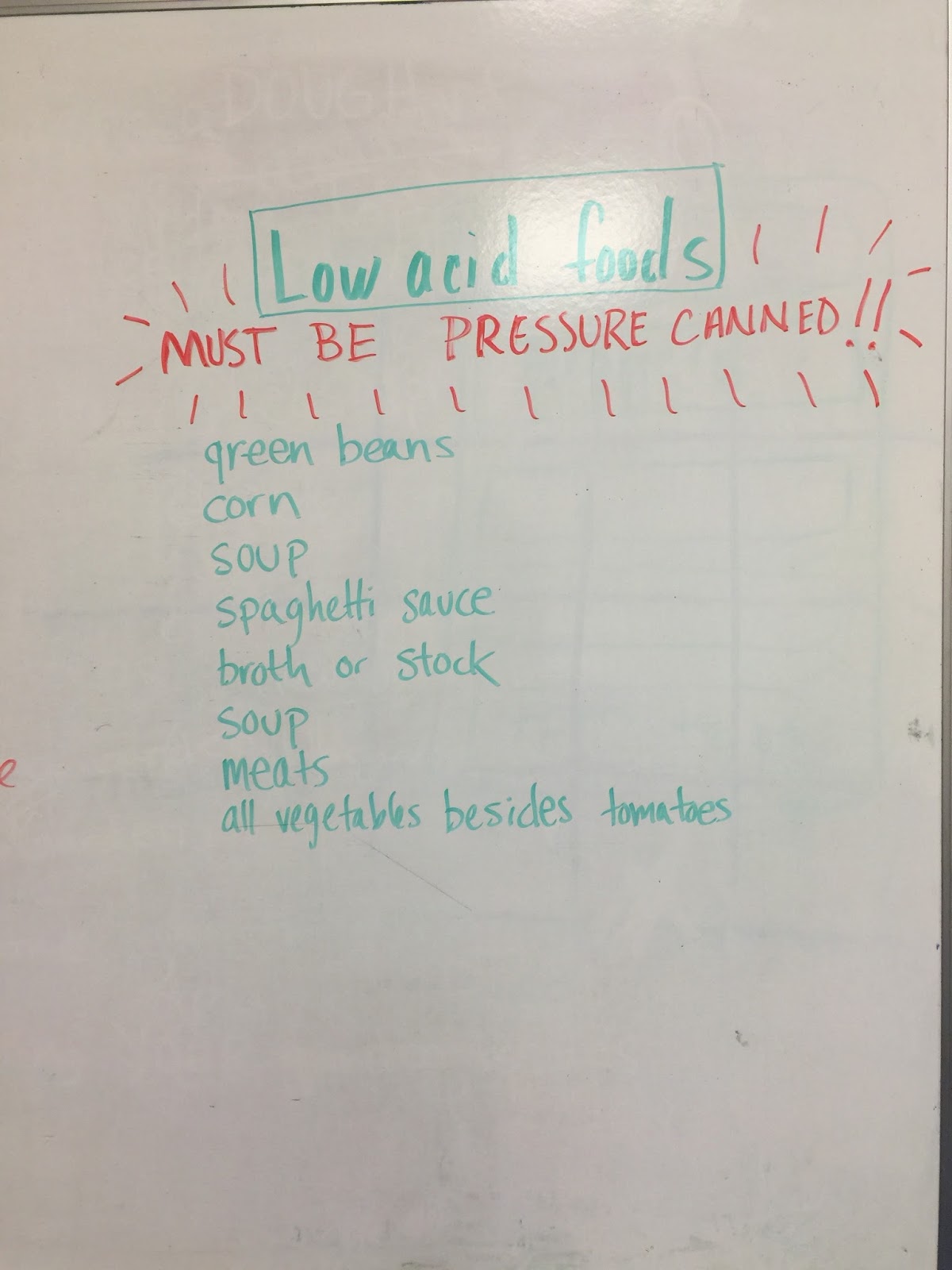
Now, bear with me here, okay? There’s only two methods of canning: boiling water bath (BWB) canning and pressure canning. The former can be used for all your high acid food needs; luckily, every fruit falls into this category, along with pickles, tomatoes (with added lemon juice) and acidified foods like chutney or ketchup. The latter is used for pasta sauce, soups, broths and veggies. Disclaimer! It is super important to use the proper method for the food your canning. Canning is a perfectly safe method of preservation, but you need to do your research, and follow instructions.

 If you’re new to world of canning, start with BWB because the cost is minimal and its used to preserve fruits and everybody likes fruit.

Next step is to choose a canning recipe from a reputable source and then follow that to the T. I mean it. Don’t try to cut corners to speed up the process. I guarantee you that every step in that recipe is for tasty food that is safe to eat. Nobody likes food poisoning; I can guarantee that. Canning is all about acid levels but you don’t need to know what chemicals do what. Simply follow that recipe and everything will fall into place.


To get started with BWB you'll need some of the following equipment:
  • Mason jars with two part lids. One to cover/seal and the ring to secure. The flat lid part needs to be new.
  • A pot that is at least 3 inches taller than your jars so that they may be submerged in water. And it needs to have a rack to keep the jars off the bottom
  • Canning tongs (DO NOT use kitchen tongs. They are not the same and you will hurt yourself)
  • Wide-mouthed funnel
  • Bubble tool (plastic knife works fine for small jars)
I know that may seem like a lot, but, you can purchase kits that have almost all of these materials for as little as $12. Great, right?

Now that we've covered all those bases, here are some fantastic resources for canning:
So, now you're ready to move forward and can the night away. Leave a comment below and let us know how it goes or if you have any question or concerns or simply share with us a recipe that you found to be a must-have. Until next time, happy canning!


Homemade peach jam


Wednesday, August 10, 2016

Thyme For Herb Education


Mother Hubbard’s Cupboard is known to have a fairly extensive garden program. We grow all sorts of veggies and fruits in an attempt to show people how simply changes to one’s routine can make running a garden so easy and simple. Among the varieties of produce that we grow (and use in our cooking demos and sampling tables), we also grow a large sample of varied herbs. I know what you may be thinking, “Herbs? Really? Can’t I focus on something with sustenance like tomatoes, squash, or strawberries and just buy my own?” To that I say, “buckle your seat belts cause I’m about to learn you a thing or two. Trust me when I say that an herb garden is a great investment.

As general knowledge when starting an herb garden, know that most herb prefer well-drained soil and sunny locations. Plants that are established require the least amount of watering and will continue to be lower maintenance as they grow. They can grow in individual pots or alongside vegetable plantings as companions. Moreover, most herbs will flower at some point. Now, in most cases this means that your herbs will be bitter after harvest so its better to harvest before this happens. Don’t worry, if you like the flowers, you don’t have to get rid of all of them, you just have to be consistent with which portions your harvesting from.

For starters, having and maintaining an herb garden is incredibly simple as most herbs don’t require tons of upkeep just the occasional trimming and watering. Plants such as Rosemary, fennel, lemon balm, oregano, and dill require occasional watering and temperature control while many herbs require even less. Why is this important to know? Well, herbs that you find in the store may come from questionable sources. By that I mean that the the taste or sought after effects of them may not be as prevalent as one would hope. By growing your own, you can control exactly when you harvest, propagate, and use your herbs ensuring that you get the most out of them for the least amount of financial strain.


Calendula
Also, this category of plants has so many different uses. The ways in which herbs can be used range from simple seasoning and tea making to aromatherapy and healing practices. What other food group can range that widely? Simply put, other herbs. You may think I’m joking here but really, take a look: lavender, mint, bay leef can be used as calming agents if boiled down to make oils for use around the home; mint, lavender, calendula, nasturtium, and chamomile can all make soothing teas while also adding signature flavors to foods and desserts; calendula, Echinacea, catnip, and nasturtium all possess healing properties that can treat flu symptoms and minor skin infections as well as assist in oral hygiene. This list is by no means extensive as it could go on and on and on and on. Of course I wish I could talk about all the different herbs but, alas, I’m going to limit it to a select few that we grow here at The Hub:
Peppermint

Calendula – flowers are used to sooth the skin, can also be used to season/flavor soups and broths.
Rosemary
Mint – makes for some very intense and flavorful teas. The scent can also assist with memory recollection. More popular in dessert dishes as an accent. Peppermint is a perennial and require spread maintenance. This means that peppermint has the potential to be invasive when planted alongside other species. Because of this, asolitary pot is recommended. Its not all bad though, with that pot youll have more mint that you know what to do with (maybe you could share the wealth). Don’t forget to trim!
Rosemary – one of the more difficult to maintain (which doesn’t say much as its still very simple), rosemary likes to be warm and requires temperature control and access to constant airflow in order to flourish. It can enhance savory flavors while cooking.
Parsley


Parsley - biennial that needs to be started from seed. Once done, parsley is very fruitful. Very popular cooking herb. Possesses copious amounts of potassium and can aid in digestion.
Basil – annual herb that thrives in the summer. Usually used by cooks as a standard in Italian cuisine. Extremely versatile and can be used as an accent in various flavors of tea.

Sage
Sage – easy to maintain perennial that is best started from seed. Used to season in savory dishes. Great for oral hygiene as it can remove bacteria in the mouth, soothe gums, and eliminate bad breath. Also makes for some interesting tea.

Now, I've given you a lot of information and surely you've already gone out and planted a whole garden with Roadrunner like speed because you guys are all extremely fast. But you may have hit a hiccup, how do you harvest and store these wonderful gifts from the earth? Not to fret, we are going to hash that out. As i mentioned before, flowers are pretty but they dont make for the most tasteful herbs samples. So, youll want to harvest before your plants flower, to do this you can literally cut off a small portion of leave and stems from different parts of the plants. These cuttings are good for immediate use. That was easy right? Im glad you think so. 

Another way to do this is to take the entire plant or a portion of it down to the root and dry it out. Drying is a very low maintenance way to store your herbs and really hone that specific flavor that you may be looking for. Remember, dried herbs are leagues more potent than fresh. To use this method, take your uprooted sample and place a paper bag over the plant and secure the bag with a rubber band around the bag and stem. Hang around your house (preferably near a window) and give an occasional shake. After a couple of days, your herbs will be thoroughly dried and ready for storage in an airtight container to be used at your leisure. 

The second way to store your herbs is by freezing. In this instance, you'll want to use your fresh herbs. Take your cutting into your kitchen and chop them up really fine. Feel free to mix different herbs together in a way that you would be comfortable cooking with and then sprinkle the mix into ice trays full of water then freeze. Each cube will contain a nice amount of flavor that can be easily popped out and added to any dish that you see fit. Doesn't get easier than that.

If you have any questions or concerns about herbs and all their glory, leave us a comment below. If you’d like to harvest some herbs for use today stop by The Hub and get some cuttings. We’re always happy to help jumpstart a garden! And don’t worry we always have plenty of thyme on our hands… get it? Its because time and thyme. I’m sorry. Until next time, we'll be harvesting!