Wednesday, February 6, 2019

MHC Advocacy Up In Indy!

Near the end of January, Hub community members trekked to Indianapolis for the Senate Committee on Financial and Insurance’s hearing on SB 104 - a bill to cap the APR rate on predatory payday loans at 36% instead of the current 391%. The hearing included the author’s presentation of the bill, testimony in support of the bill, and testimony in opposition of the bill. Hub folks had lots of thoughts about the experience!

There was the good, like seeing the process firsthand and working alongside other Hoosiers invested in restricting predatory loans. 
Chuck Roldan: “I was impressed by the credentials of everybody who talked. The Institute for Working Families person, Erin Macey, had everything - a compelling, complete line of thought.”
Joelle Parker: “I’m glad I went, I haven’t been before.”
Lilly Bryant: I was proud to go up to the statehouse where they make all the important things happen. Walking into the room up there made me proud also to be in a country where us women have a voice and choices to help with these bills.

But there were also frustrations, some about the committee process, and who it is and isn’t accessible to.
Laxmi Palde: “It speaks volumes [...] just seeing that most of these legislators are older, and male, and white and they’re talking about something that affects communities and demographics different from that. Seeing the lawmaking process in action was pretty sad. That was the first time when I was like maybe I should run for office  in the future.” 

Joelle: “They divided up the testimony to where we said ours, and then the other side did. The last say is the one they’re going to remember the most. I wish we had a different pattern - one presents, then the other, then you can present after or at least get a minute to say something back.”

Chuck: “There was a gap in terms of personal testimony. There wasn’t anybody [who had used a payday loan] in the room. I imagine that a lot of Hoosiers who have taken out loans probably wouldn’t be able to take off a random tuesday at 1pm and drive an hour to Indy.” 

...And some frustrations about what seemed to be social norms in the committee meetings.
Chuck: [Committee members] were hanging out on their phones.
Laxmi: and leaving the room...one guy was falling asleep.
Joelle: I complained when I got home about the guy from my county getting up and leaving - it seems disrespectful.


Hubsters also had thoughts about the content of testimony and committee members’ questions. 
Chuck: There was a line of questioning that was really concerned about a gap in services that could occur if payday lenders were barred from the state. [...] I guess that’s one way of looking at it. I kept thinking that it’s the same way that when you open up a bag of potato chips, you’re never less hungry - it doesn’t even fill the gap. And also another way of framing it, is that the gap that Senator Bohacek was talking about has a name - and that name is poverty. It’s much bigger than this. [...] Payday loans are a part of the larger poverty tax that we inflict on low income people.”

Joelle: They acted like the government was going to have to pick up for everybody, making it into a socialist thing. But that’s not really true. We have things that [...] could be a solution to fill the gap. I think that we just need to focus on that.


Another big surprise? The level of information committee members seemed to have about the bill. 
Chuck: One thing i was kind of surprised by, a lot of the people on the committee were just wanting to learn.
Joelle: It’s hard to believe that they just don’t even know the laws that are impacting their constituents so harshly.
Laxmi: A lot of them were asking basic questions well into the meeting that were answered very early on.


Hub folks also noted that there were recurring misconceptions brought up about who uses payday loans. 
Chuck: One person [offering opposition testimony] used the phrase ‘unbankable’ population, which makes sense if you’re talking about states where people don’t have to have a bank account to open a payday loan. But Indiana has the regulation that you have to have a bank account [to take out a payday loan]. It’s also such a loaded word. It’s like ‘good for nothing people.’

Joelle: They said they were going to go buy drugs with the money, instead of things like ‘I’m going to bury my dad.’ The reality of it is that really horrible things are happening to people like, ‘I’m six months behind on my rent and they’re kicking me out tomorrow.’

Laxmi: They asked questions like ‘What is the profile of someone who would take on a payday loan?’ [...] That kept coming up. Where are these payday loans or lenders concentrated - is it in communities where there are lots of drugs? It was sad that it had to be a part of the conversation. That seemed to be the preconceived notion.

When asked if they wanted to rebut anything else that had been said, or wished something had been brought up, Hub folks noted the following. 
Chuck: The gap comment. They [payday loans] don’t even fill the gap!
Laxmi: And some basic fact checking! They kept bringing up [...] that people can’t take out multiple loans, but they’re sort of working around the reality.
Chuck: Yeah...you can take one, and your partner can take one. And they kept on talking about the modal number of loans that people take out as two - they didn’t talk about the mean or median, which I felt would be more useful. The middle-of-the-road payday borrower takes out how many loans? That might be a useful statistic to know.
Joelle: But it also only takes one of those to completely destroy you at 400% apr. That would be my rebuttal.

And last but not least, Hub folks had this advice for folks considering going up for a committee hearing. 
Chuck: Don’t count on the legislators to know anything about the bill. Maybe prepare two testimonies - one for experts and one for novices, and you’ll quickly see which one you need - probably the one for novices.

Joelle: Dress up to the nines, as best you can. Get straight to the chase - tell them something very startling for your first thing, and how it affected you personally. Just talk about that and have it be from the heart, because that’s what affects them. If there’s any way that you could communicate, ‘how would you feel if it was your brother, your mother, your grandfather - you - who had this happen to them?’  And then that brings it home to them.

Laxmi: Know that you bring a unique perspective that won’t be heard otherwise in that room, and using that to your advantage. And carefully crafting your words so that they’re as impactful as possible.


Thursday, January 24, 2019

Sourdough Bread Workshop 2019

On January 23, we had an awesome workshop where we demonstrated how to start a starter for sourdough bread and how to shape it to then cook. We had a great turn out and an even better taste test. Thanks to those who joined us, be sure to look out for our next workshops 'Things on Toast' and 'Growing and Cooking with Microgreens.' We hope to continue to get everyone involved in these events so spread the word!


Tuesday, January 22, 2019

MLK Day of Service 2019


Yesterday we held our annual MLK Day of Service. We had a great turnout of about 50 volunteers who helped deep clean the pantry and set up for the spring 2019 gardening season. We are so grateful for all the hard work the volunteers put in and all the work they were able to get done. In addition to that, we introduced several upcoming advocacy events that we are looking for more community members and volunteers to join. If you are interested in learning more about that, we have an upcoming Hub Dinner on Tuesday February 5th from 6-7:30. Feel free to stop by, grab some food (vegetarian- friendly), talk through several current state- level bills, and get training from our friends at Hoosier Action on how to “Hustle.” No experience necessary- for additional questions contact Hannah at community@mhcfoodpantry.org or 812-355-6843. We hope to see you there!


Wednesday, January 9, 2019

TANF: Why Changes to this Outdated Program are Vital


At the Hub, we believe that access to healthy food is a basic human right. In addition to our work in the food pantry, community gardens, and kitchen, the Hub's advocacy program looks at the root causes of hunger and supports policies that help community members get the food they need. This year, MHC advocacy interns dove into researching the TANF program (Temporary Assistance for Needy Families), sometimes better known as cash assistance. This program, which has enormous potential to help community members access much-needed financial support, has a complicated history in Indiana. To learn more, keep reading!

About TANF

TANF is a safety net program designed to help families achieve self-sufficiency through programs such as child care and cash assistance, contingent upon fulfillment of specific work requirements from both the state and federal government. 
TANF is federally funded through block grants, which means that states are given a bulk sum of money that they have the flexibility to use as seen fit. When it was established in 1996, supporters of this structure said that states would use this flexibility to redirect funds from cash welfare to longer-term programs to promote self-sufficiency. In TANF’s early years, this was the case. However, over time, states (including Indiana) redirected large portions of TANF funds to other purposes, such as filling state budget holes. Even during the Great Recession, when this program was all the more necessary, these funds were not redirected to the core welfare reform services that are meant to provide safety nets for families in crisis; instead, budgets were cut.
Cash assistance is one of three of these core welfare reform services. In 2016, only 6% of TANF funds in Indiana were spent on cash assistance, down from 29% in 2001. To be clear, 50,000 families in Indiana experience deep poverty, yet fewer than 8500 received cash aid.
In stark contrast, a staggering $96 million—32% of TANF funds—were allocated to a vague category labeled “Other.” Representatives from the Indiana Institute for Working Families said they investigated and were unable to acquire information regarding what expenditures constituted this category.

States set their own eligibility requirements for receiving TANF benefits. In Indiana, work requirements to receive TANF benefits are not flexible. This prevents families who face barriers to consistent employment from receiving assistance. For example, families and individuals experiencing mental and physical impairments, substance abuse, domestic violence, learning disabilities, problems with housing, childcare or transportation might be unable to fulfill the work requirements and thus don’t qualify to receive benefits.
States also have the flexibility to set benefit levels. According to the Center for Budget and Policy Priorities, TANF benefit levels are not high enough in most states to lift a family of three above the poverty line. This is telling, considering that TANF’s ultimate objective is to help families achieve self-sufficiency.
From 2015 to 2016, only 7 out of 100 Hoosier families in poverty received basic assistance through TANF, compared to 45 out of 100 families in poverty from 2003 to 2004. Furthermore, since its establishment, the program has not been adjusted for inflation. Benefits, around $288/month for a family of three, have lost more than ⅓ of their value. Structural revisions to this outdated program are long overdue.
The appalling data about TANF is only the tip of the iceberg. We must remember what the inability to access vital support does to families—it keeps them in a cycle of poverty that is, for many, economically impossible to escape. Thousands of families in deep poverty are unable to seek healthier lives, food, and opportunities; the way TANF works right now, benefits are out of reach for American families who need it the most.

Take Action

A TANF bill that would adjust the income eligibility requirements to make benefits more accessible has made an appearance in the IGA session for the past two years. Though it received hearings, it never made it to a full floor vote. But the upcoming year could be different with enough community support. According to the IIWF, state legislators are working to raise income eligibility levels for TANF from 16% of the federal poverty line to 50%.
If you or someone you know, has experience with TANF or other safety net programs (SNAP, Section 8, CCDF, etc), you can share your story with the Indiana Institute for Working Families (IIWF) here.
IIWF is also collecting signatures in support of legislation to raise eligibility and benefit levels for TANF. Sign on here.
Update: The TANF bill (Senate Bill 440) has been filed as of January 10! Find out more here.


Monday, October 1, 2018

Andy Fisher Talk: Are Food Pantries Really the Answer?


This blog post was written by Jessica McKinney, the 2018-2020 SPEA Fellow.

"Instead of fighting hunger, shouldn’t we be preventing poverty?” - Oscar Wilde


On September 5th, 2018, The Hub co-hosted a conversation with Andy Fisher, author of Big Hunger. In his book, Fisher outlines how the emergency food system, once a stop-gap for individuals and families in need, has become a fixture in communities across the US. Andy spoke about a variety of topics pertaining to emergency food systems that connect back to his book, but one question really stuck out.

Do food pantries really “solve hunger”?

                                         
Andy answers with a firm No, stating in his talk, “Charity is not a bad thing, but it is a BandAid to the real problem.” He argues that we are only temporarily fixing a small part of a bigger picture issue that society doesn’t want to acknowledge. This argument is not one that is dominant in emergency food systems right now, but individuals and organizations, like The Hub, want that to change. By inviting a speaker like Andy to talk about these issues, a conversation can finally start on how to shift towards long-lasting change. Janet Poppendieck, author of Sweet Charity? Emergency Food and the End of Entitlement, also pushes for more than surface level solutions, saying that food pantries were made, and the majority to this day are still used, to combat immediate, short-term hunger. Long-term problems should not be met with short-term solutions -- which, then, begs the question, what should we be doing instead to try to solve hunger?

As Andy put it, “We all know this intuitively... a can of beans isn’t going to solve hunger, it has become a BandAid on what has become stage four cancer in our society.” 

Instead of looking at hunger as a surface level issue, we should be analyzing the systematic barriers that lead to people being hungry. Andy asserts that “Hunger is a symptom of poverty” and that, “African Americans tend to be at higher rates of food insecurity than Whites…[and] Women, especially single moms, tend to have higher rates of food insecurity.” It isn’t a coincidence that these groups are in poverty more than others; Karen Washington, a community activist, says that it’s clear that the real reasons for women and people of color are the most impoverished are systematic, in nature. The country and its government were founded on sexism and racism, and barriers have been set in place for decades against women and people of color that have caused these two groups to be the most impoverished. Gentrification, redlining, lower wages, food desserts, and lack of a social safety net are only some examples of these barriers.

So now that we’ve acknowledged that poverty is a result of systematic powers, what can we do to end it? Different people have different answers, but The Hub suggests bottom-up change. We invited Andy Fisher to Bloomington, IN because we know, and advocate, that food insecurity does not exist in a vacuum. This issue contains multiple factors that have to be considered when making a call to action to prevent poverty and, in effect, prevent hunger.


For any who went to the talk or maybe a few of you after reading this, you might be thinking to yourselves, This brings up a lot more questions than solutions! Don’t worry! We get that and want to direct you into a place of determination and action, instead of the bottomless pit you are looking down. 

The Hub hosts a monthly dinner to connect community members and offer space to discuss food access, housing, healthcare and more. Join us for an upcoming Hub Dinner to connect with neighbors and friends over a delicious meal, dig into tough discussions, and take action together. Our next meeting is October 22nd and the food is always great (If we do say so, ourselves)! Please check Facebook for other dates, going forward.

Friday, February 9, 2018

Reflecting on Coffee Talk and Community

This blog post was submitted by the Hub's Advocacy Intern, Zahra Bhoy.

I’ve been interning at the Hub for about a month now, and it seems like every time I go in to work, I fall more and more in love with the place. From interacting with fellow interns and Hub staff at implicit bias trainings to collaborating with community members at meetings for the Food and Farm Coalition, I’ve constantly been learning and being exposed to different ideas. However, I’d have to say that some of my favorite moments at the Hub have been interacting with patrons during my Friday coffee talk.

A coffee talk is basically when an intern from the Hub offers coffee or tea to patrons in the pantry and talks to them about anything from upcoming advocacy events to how their day is going. I’m not going to lie, when my supervisor Stephanie first told me I’d have to conduct weekly coffee talks, I was a little scared. Would people walk right by me and ignore me? What would I talk about? Would people hate me because I made really bad coffee?

Needless to say, I was freaking out about nothing. For my first coffee talk, I decided to make tea instead of coffee (pretty hard to mess up boiling water, right?), and it ended up being so much fun! I guess I was expecting the hour to be filled with a bunch of small talk and conversations about the weather, so I was surprised when patrons actually wanted to talk to me about what was going on in their lives. I’d offer a simple “Hello, would you like a cup of tea?” and we’d end up in a long-winded conversation about how two patrons were in the same college class 20 years ago.

I also love people watching, so even if I wasn’t engaged in a conversation with someone, it was still fun to watch the daily bustle of the pantry and overhear conversations of patrons making plans to get coffee or bickering over everyday things. One of the Hub’s main beliefs is that building communities and support networks is vital for combating food insecurity, and it was so cool to witness how the Hub was building a community right here at the pantry.

Interning at the Hub has been an awesome experience so far, and I’m so excited to see what the Hub has in store for the next few months.


Wednesday, January 31, 2018

The Indiana General Assembly is in Session!

While much of the news is centered on the United States Congress and the federal budget, Indiana’s General Assembly is currently in session, proposing laws that will go into effect as early as July 1st, 2018.

The Indiana General Assembly (IGA) is a bicameral legislative body, similar to the U.S. Congress. It consists of a House, with 100 members serving 2-year terms, and a Senate, with 50 members serving 4-year terms. A major difference between the IGA and the Congress, is that Indiana runs on a 2-year budget cycle. We are currently in the middle of our budget cycle, and so the IGA is in a short legislative session, running from January 3rd-March 14th, 2018. Although this is a short session, many of the proposed bills will have quite an impact on Hoosiers across the state.

One of the most important bills for those dealing with food insecurity is Senate Bill 11, “Eligibility for supplemental nutrition assistance.” This bill would remove a restriction that prevents certain individuals convicted of drug offenses from receiving SNAP benefits (food stamps). Indiana is one of only four states that does not allow these individuals to receive SNAP benefits.

SB 232, “Access to nutritious food program,” would establish a program under the Indiana Housing and Community Development Authority, with the goals of “(1) distribution of fresh and nutritious food; and (2) education in food preparation and nutrition in food deserts.”

HB 1285 calls for stricter eligibility and identification requirements for those who receive SNAP benefits or Medicaid from the Family and Social Services Administration of Indiana. The bill proposes identity verification at least four times a year, as well as work requirements for receiving certain funds. The IGA will have a committee conduct a summer study on these possible changes and their cost.

Other bills of interest...
SB 418, “Bias motivated crimes,” would be Indiana’s Hate Crime law. In response to events around the country and the world, it is time Indiana took a stand to protect those from being discriminated against for the race, religion, or sexual orientation. It would also require all crimes of this nature to be reported to the Federal Bureau of Investigation. This bill has support from the leading legislators and will likely be enacted.

SB 93 / HB 1390, both of these bills deal with fair and equal pay. These bills would make it illegal to pay discriminate wages, based on sex, race or national orientation for the same job. If passed, the Indiana Civil Rights Commission would have jurisdiction over complaints.

The Indiana Chamber of Commerce provides a wonderful resource about the process of how bill proposals become law.

To follow current proposals and proceedings consider joining Ping the People. Receive daily updates on the bills you care about.

Wednesday, January 3, 2018

Food and Farms Coalition Call Out


One of the major pieces of legislation that will be on the docket in 2018 is the Farm Bill, a comprehensive, multi-year law that governs the agricultural and food programs that undergird our entire food system. Indiana Senator Joe Donnelly is a member of the Senate Agriculture Committee, and will be instrumental in drafting a Farm Bill that works for all Hoosiers. We appreciate that Joe Donnelly took the time to meet with emergency food providers in Lafayette this November, as part of his listening tour of Indiana concerning the 2018 Farm Bill. During this listening session, we spoke about the fundamental need for SNAP (Supplemental Nutrition Assistance Program) in Indiana, where food insecurity is still increasing.

On December 5th, Senator Donnelly sent a message recapping his takeaway from this tour. In this email, he stated support for a host of commodity agriculture programs, biofuels and rural community investments, but nowhere did the Senator mention SNAP, or family farms. These are notable omissions; SNAP makes up about 80% of the Farm Bill funding and Indiana has over 40,000 small farms, which are struggling to make ends meet while bringing nutritious food to our communities.

SNAP is in real trouble in this political climate. The tax bill that recently passed will increase the federal deficit drastically, and republican lawmakers have stated that they are now looking to create substantial budget cuts in coming years to social safety net programs, including SNAP, in order to address this shortfall. SNAP cuts would be devastating to local economies, and to the 1 in 8 Hoosiers that depend on SNAP to eat. Nearly 75% of SNAP benefits go to households with children or someone with a disability. These children require healthy food to learn and develop into productive citizens and SNAP is by far the most efficient tool that we have to fight hunger in the US. Food Banks and private charities can only provide 5% of the groceries that hungry Americans need. Government nutrition programs provide the rest.

We need to work with Senator Donnelly to shape a Farm Bill that supports the small farmers and sustainable farming practices that are vital to local food security in Indiana, and to the health of our rural communities. The Center for Disease Control finds that farmers and agricultural workers are 5 times more likely than other kinds of American workers to commit suicide. The rural communities that depend on the health of small farms are suffering. These communities instead need a Farm Bill that prioritizes the success of diversified family farms, the needs of agricultural workers and the health of the land itself. They also need the localized economic boost that SNAP spending creates. According to the USDA’s Economic Research Service, every $5 of SNAP benefits spent generates $9 of localized economic activity. Decreasing SNAP spending in Indiana will further depress the economies of Indiana towns.

At the Hub, we know that our entire community is affected by the food industry; as workers, as eaters, as food stamp recipients. That's why we can't ignore the upcoming reauthorization of the Farm Bill. So, we are launching the Food and Farms Coalition (FFC) to organize for a smart Farm Bill. The FFC includes the Hub's Advocacy Working Group and Hoosier Action, working together with small farmers, SNAP recipients and those concerned about the food system. We need to make sure that the Senate hears the voices of Hoosiers too long ignored. If this includes you, join us on Tuesday, January 9th at 6:30pm at Sacred Heart Church, 615 N Fairview St. to build power!

Monday, November 27, 2017

Launching the Food and Farms Coalition

At the Hub, we know that our entire community is affected by the food industry; as workers, as eaters, as food stamp recipients-- that's why we can't ignore the upcoming reauthorization of the Farm Bill. As a result, this year we are launching the Food and Farms Coalition (FFC) to build power!  The FFC includes the Hub's Advocacy Working Group and Hoosier Action, working together with small farmers, SNAP recipients and those concerned about the food system.

Hoosier Action launched in April 2017 to build the political power of Indiana's working families through robust community organizing. They take on campaigns around economic and social issues that impact everyday people across the region.

The Hub's Advocacy Working Group aims to address the issues of poverty and injustice that lead to food insecurity. Our core issues are food security, affordable healthcare, and affordable housing. The Food and Farms Coalition will launch our first Farm Bill campaign.

The Farm Bill is a congressional bill that re-authorizes every 5 years or so, and it dictates how much funding will go to food and agriculture programs in the U.S. Our current Farm Bill is going to be expiring on September 30, 2018, so there are some changes that may occur. We want to provide as much information as we possibly can on this year's Bill so that everyone can benefit from it, working together to ensure the Bill is fair to agriculture workers and buyers and all those affected by food insecurity.

Our Indiana Senator, Joe Donnelly, sits on the Senate Agriculture Committee, which works directly on the Senate's version of the Farm Bill.  As his constituents we need to let him know what we think, and how he can best represent us.

Let's work together to stay informed, raise our voices and work toward a strong, healthy Farm Bill.  The Food and Farm Coalition will meet monthly, please join us tomorrow, Tuesday, November 28th at the Hub from 6pm-8pm to get started!

Monday, November 20, 2017

Cuts to Food Stamps


“SNAP has helped me out several times in my life. In college, it's how I ate. Now, I use it to help me buy food since I live paycheck to paycheck.” -SNAP recipient, Hub patron


In March, President Trump proposed $193 billions dollars in cuts to the Supplemental Nutrition Assistance Program (SNAP), formerly known as Food Stamps. These massive cuts would be a drastic blow to one of the most effective hunger and poverty prevention programs in the United States. A program that has:
  • Lifted millions of households out of poverty: SNAP kept 10.3 million people out of poverty in 2012, including 4.9 million children.
  • Helped families put nutritious food on the table.
  • Promoted long-term health and well-being, especially for children.
  • Provided a valuable safety-net, both during economic downturn and natural disasters.
In Indiana:
  • It kept 224,000 Hoosiers out of poverty, including 111,000 children, per year between 2009 and 2012

How will these cuts affect Hoosiers in Monroe County?

In Monroe County, over 25,000 community members experience food insecurity - the second highest rate of food insecurity in the state of Indiana. Of those families and individuals, nearly 8,000 receive SNAP benefits, and it serves as a valuable resource for putting food on the table.


If these funding cuts go into effect, thousands of Hoosiers will no longer be able to afford a healthy diet. Nearly 75% of SNAP benefits go to households with children or have someone with a disability. While we would hope these would be the last groups to be affected by any changes, there is no guarantee when such a large sum of money is involved. If federal funds are cut, we will be unable to count on the state of Indiana to fill the gap with a tight state budget.


If SNAP benefits got cut...“[i]t would make it harder to pay the bills on time. Either a bill wouldn't be paid or I would sacrifice food for bills. I make less than what I owe. I am very fortunate to have found resources for food from my friends, from growing my own food, and from organizations like the Hub, but many people in a worse situation really struggle. They will get very low quality food if enough food at all.”


Sources:

https://www.snaptohealth.org/snap/the-real-benefits-of-the-snap-program/

https://www.cbpp.org/sites/default/files/atoms/files/snap_factsheet_indiana.pdf

Wednesday, November 1, 2017

Building Social Inclusion at the Hub!

Submitted by Advocacy Intern Meagan Wilson. 

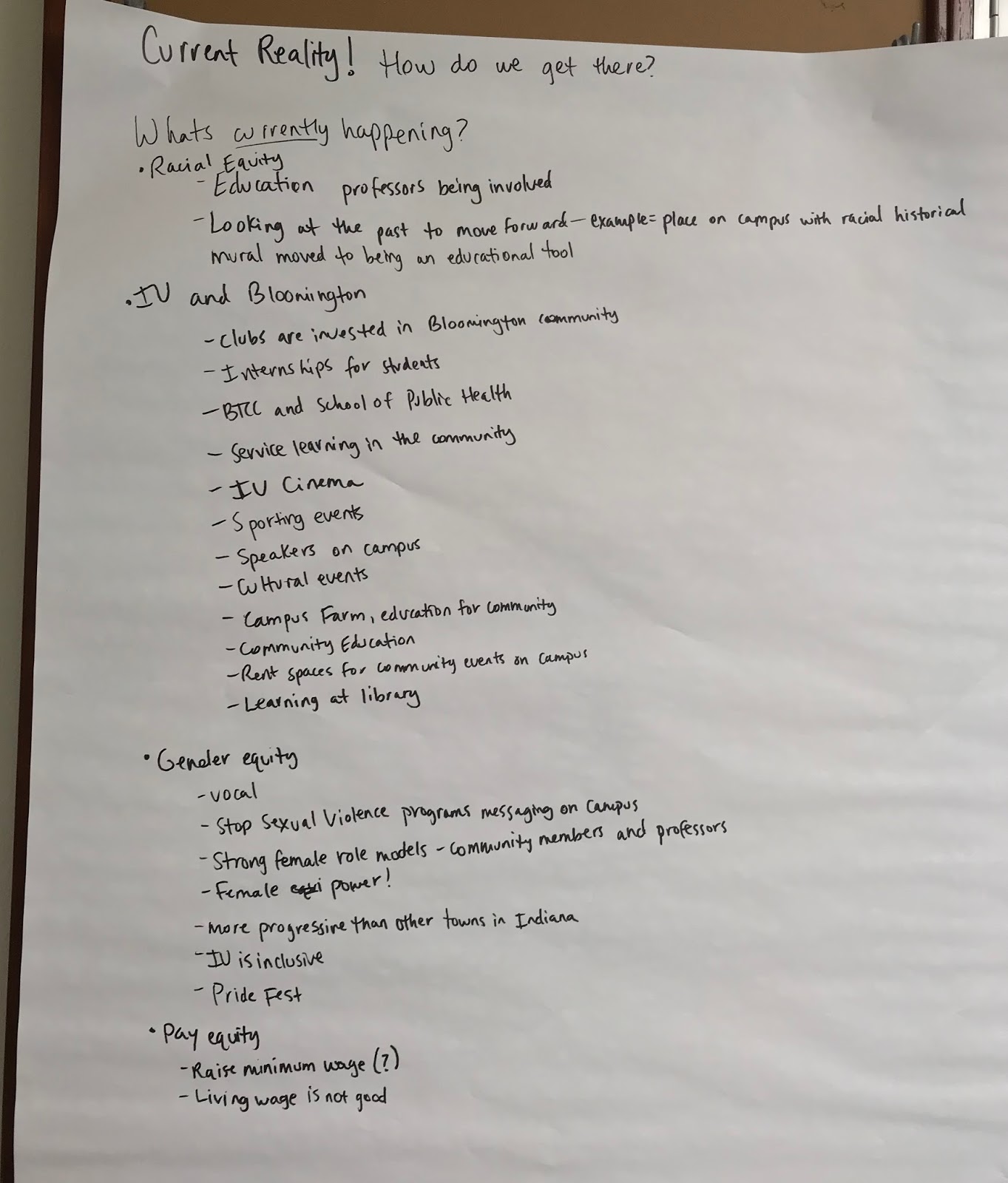
Last night, the Hub got together with BTCC Bloomington to discuss social inclusion in the Bloomington community!


Our ideas about the current reality of social
inclusion in Bloomington
Gaging the amount of progress made on social issues
in Bloomington


Social inclusion is a topic of vital importance here at the Hub. Promoting social inclusion is one of our foundational beliefs, and we want to foster it in the community as much as we can. Bloomington still has a long way to go in terms of racial, gender and income equality, but it isn't too late to start making progress.

We understand how much social inclusion can impact our patrons and friends -- oppression and inequality are the cornerstones of poverty and food insecurity. That's why in every community, it's so important to build inclusivity. We want to build support networks, change systems, start conversations and look out for one another.

During the talk, we discussed big picture ideas for fostering social inclusion: raising the minimum wage, bridging the gap between Indiana University's campus and the city of Bloomington, and investing in infrastructure so as to provide low-income individuals affordable housing. However, these aren't all that you can do for helping create a more socially inclusive community; sometimes, grassroots changes can make just as big of a difference as big picture ideas. Start talking to your neighbors, reach out to people who might need help, and stand up for your community in everyday situations. Encourage education and compassion. If everyone contributes to our vision of a more socially inclusive community, it could become a reality sooner than we think.